
Josh Simons the now former MP for Makerfield has fallen on his sword and taken up the Chiltern Hundreds, a Crown office that disqualifies someone from being an MP therefore leaving a by-election opening for Andy Burham the man who believes he is Keir Starmer’s nemesis, to acquire a seat in the House of Commons. In order for Andy Burnham the current Mayor of Greater Manchester to be able to challenge Starmer he needs a seat in the House of Commons which is why Josh Simons gave up his seat, but it is all a very big gamble. Things could go swimmingly for Burnham and he could win and therefore be eligible to challenge Starmer for the Labour leadership. Of course, it could all go the other way and Josh Simons sacrifice could all be for nothing if Burnham loses.
Because of how much is at stake with this by-election, it’s going to be a very very high profile by-election contest indeed. Unlike many other by-elections this one could potentially be one for someone who is likely, if elected, become the next Prime Minister and maybe the Prime Minister until 2029. One of the quirks of the British Parliamentary system is that one man can be elected to one seat then is propelled into the leadership of both party and Government. The Americans nor the Germans nor many other nations could potentially change their head of government in this way. By the way I’m not saying it’s wrong to change a head of government like this I’m just pointing out to my overseas readers just how the British constitutional settlement can sometimes work in this decidedly strange seeming way.
The odd nature of this by-election is going to be a magnet for the Press both mainstream and alternative and I predict that the ballot paper might be slightly longer than usual for a by-election. This is because it is going to have to accommodate not only the party that won the seat last time, Labour, the second place party Reform and the usual Tories and Lib Dems, but all the large number of minor parties, independents and attention seekers that such high profile contests attract.
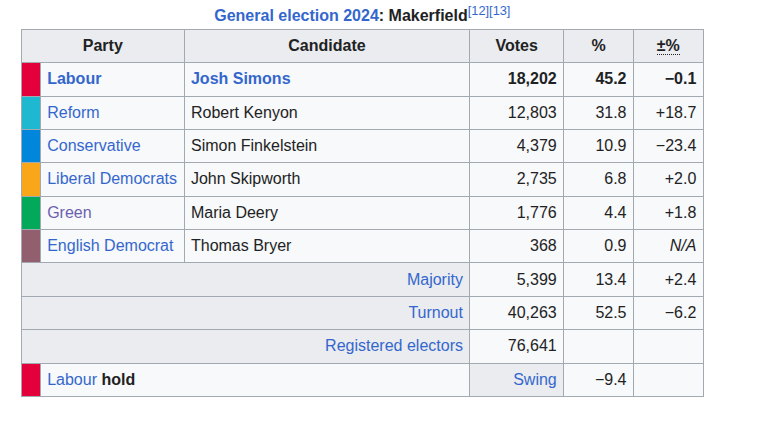
Last time this seat was fought in the 2024 General Election, Labour won the seat with Reform 6,000 votes behind. The Conservatives and the Liberal Democrats both keeping their election deposits by polling more than 5%. The Greens got 4.4% and the nationalist Right party, the English Democrats, got 0.7% of the vote.
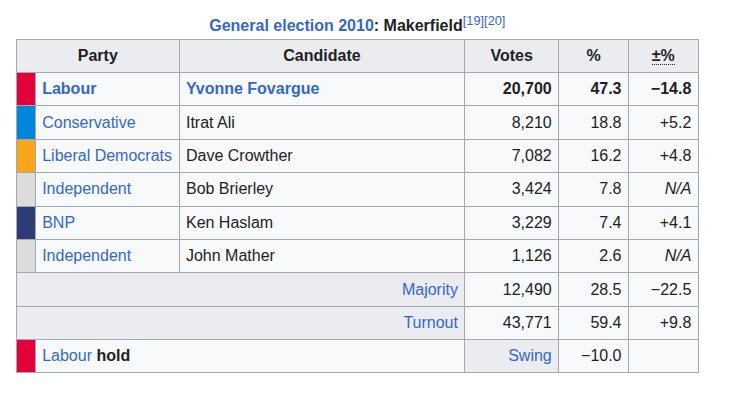
The seat has been in the hands of the Labour Party since its creation in 1983, other parties have come a very poor second so deeply rooted were the Labour Party in the area. But things started to shift politically in recent years. Labour’s hold over the seat started to weaken at first, in the 2010 General Election where Labour came under pressure from a rise in the Tory and Lib Dem votes but also a fifth place showing for the British National Party.
Labour recovered a bit in 2015 but this time the second place was taken by the United Kingdom Independence Party (UKIP) but up until the 2024 General Election nationalist parties like UKIP or the Brexit Party or Reform or similar have not occupied second place. This constituency has been, for most of the time since its creation a straight fight between Labour and the Tories, with apparent local public disquiet at things like immigration, the EU and a general disillusionment with the Big Three parties being expressed by votes for minor parties. The strong showing for the BNP earlier this century may reflect a local feeling against immigration and its likely that the BNP picked up votes because they were one of the few parties talking about this issue at the time. That’s not the case now or recently. There are now more parties out there talking about immigration as the political Overton window seems to have shifted and being critical of immigration is no longer the preserve of neo-Nazi parties such as the BNP. It is possible that much of this constituency’s anti-immigration, scepticism about multiculturalism that may have gone at first to the Tories and to a lesser extent the BNP but that vote block might now be being channelled into Reform and its previous incarnation The Brexit Party.
As by-elections go a gap of 6,000 votes between the winner and the second place as was the case in the 2024 General Election is a significant barrier for Reform to hurdle but it is not an impossible one for Reform to get over but it will be a hard fight for every vote. Labour or rather the supporters of Andy Burnham will throw everything including the kitchen sink at this contest because it is one that has so many implications for both the Labour Party and the country. Kemi Badenoch’s Tories also have a lot to prove here as this is their first major electoral contest since the local elections when they lost a lot of councillors often to Reform. The Tories don’t have much of a chance here going by the psephological data (see link below) but it remains to be seen whether they will hold their own here or whether their previous voters have mostly decamped to Reform? I think they’ll keep their deposit here but I’m not sure whether the Lib Dems if they stand here will do the same. The Lib Dems have lost their deposits in three out of the last four General Elections and it’s likely to be the case that this will happen again. They might pick up some votes from the politically disconnected who wish a plague on both Labour and Tory houses but I don’t believe that they will take a significant number of votes.
At the time of writing only the Monster Raving Loony Party and Restore Britain have named their candidates in this election. Howling Lord Hope is standing for the Loonies and a woman from the world of horses, Rebecca Shepherd is standing for Restore.
We do not know if Andy Burnham will be approved to fight the seat for Labour as that is most likely down to Labour’s National Executive Committee (NEC) and that might also depend on how much personal power Starmer has to influence the NEC. He could block Burnham but he then plunges the Labour party into open internal conflict so it’s likely in my view that the NEC will approve Burnham for Makerfield.
On a personal note, opponents of Labour, whether from the Left or from the Right should want there to be a balls up in Labour. This government has been truly awful and has vandalised society and the Constitution in the short time they’ve been in power, therefore exploiting internal dissent in Labour might be a useful political weapon against a Labour party that is no longer for Britain’s labouring classes. The chaos within Labour if Burnham stands and loses to Reform the nearest challenger in Makerfield will of course be fodder for the growing multiparty opposition to Labour and help them to gain support. But the chaos might also help to improve the standing in the Labour Party of the Blue Labour faction who are much more attuned to the feelings and views of the ex Labour voters who’ve decamped to Reform than the middle class left blob that appear to control Labour at present.
If Burnham wins and then takes the leadership of the Labour Party and therefore also becomes Prime Minister then there’s some second order consequences that might follow. There’s talk of Burnham might allow the tens of thousands of low skill, low education migrants who came in during the Boriswave of migration to settle here. Burnham clearly is not on the side of British opinion with regards to migration if that really is his intention.
Tactically if voters want to send a message to Labour about their complete mismanagement of Britain and throw a spanner in Labour’s internal workings then whether they would normally be Tory, Lib Dem or a supporter of one of the smaller parties or a floating voter, then a vote for Reform would achieve that. There’s a whole lot more at stake here than just another by-election vote. Indefinite Leave to Remain for the Boriswave, a side lining of the politically reasonable Blue Labour faction, a possible Burnham led government attempt to reverse the 2016 Brexit referendum result and much more. Burnham could do a whole lot more damage to Britain, its society and its economy if he wins.
Personally I’d hold my nose and vote Reform if I was a resident in this constituency just as I’d vote Reform in my own constituency if my party of intellectual choice, the Social Democratic Party was either not on the ballot box or not polling well in my constituency.
There’s been a lot of controversy over the decision of Restore to stand a candidate. There are many arguments in favour of Restore not standing in this one and equally many answers why they should.
One argument as to why they should is based in idea of the purity of the democratic slate at election times. Every party representing all types of viewpoints should have the ability to stand for election, as long as they can come up with £500 they can get their names on the ballot paper. An election under the British Parliamentary system is a true marketplace of ideas. It’s an arena where any cause can get their chance to speak and this is why high profile elections such as those in Gorton and Denton and the upcoming one in Makerfield may well attract a massive undercard of minor parties and independents. Yes there are arguments to be had about the high bar for election that the First Past the Post electoral system creates, but that’s separate discussion from the one about the open market for ideas that Parliamentary elections creates. Sometimes parties that start out small, such as Labour were in the very early part of the 20th century, become big ones through externalities such as the extension of the voting franchise and by being specifically a voice for the working classes at a time when the working classes quite rightly demanded to be heard in the halls of government. Reform has grown from a movement that started with a few people in the late 1980’s and into the early 90’s kicking around a few ideas about sovereignty, the EU, economics and social policies that were dreadfully unpopular at the time in the country. Through the Referendum Party, UKIP, Brexit Party and now Reform, these currents of ideas from decades ago have been the foundation of a party that has found its core constituency of those who are unhappy with how Britain has been previously governed and who see no shame in being patriotic or putting the needs and wishes of Britons to the fore.
The argument for Restore standing in this by-election is that they have the same right as any other party to set out their stall for the voters. Restore voters are filling social media with bold claims that they will win this seat, which I do not think they can do even if they pick up all the votes from the anti-immigration maximalists who might have voted BNP earlier this century. However they do deserve the right to stand, even though this is a party that I will not touch with the proverbial bargepole for reasons I have given recently.
As we can see from the history of the Labour Party and of Reform via its predecessor parties, sometimes small parties can grow into larger ones over time and maybe Restore should be allowed their spot on the political seedling tray to see if they can grow?
One argument against Restore standing is less to do with the purity of the democratic slate and the ability of every viewpoint to set out their stalls in elections and is much more cold hearted and tactical. With Reform in a not impossible position to win this seat there is a danger that votes from the fanboys and fangirls of Restore trapped in some sort of purity spiral politics and who think that Reform are not ‘hard enough’ might allow Burnham to take this seat and therefore bring about the second order negative effects that I wrote about earlier. It’s likely that this election will go right up to the wire and it might be a very few votes that make the difference between Burnham winning and being able to sow chaos into an increasingly hated Labour Party.
If you want to lob a political grenade at Westminster and into the Labour Party then it looks like a Reform win might be the best way to do it. The Tories can’t and nor can the Lib Dems and I very much doubt that any undercard party or independent would do it either. Perfection cannot exist in practical democratic politics, sometimes we have to vote for something that might not be all that we want either in a party’s policies or personalities but it gets the job done. Those in charge of Restore should really have put their egos away and looked at the electoral numbers and either stood a low profile ‘tester candidate’ to help to build local political infrastructure or not stood at all. My greatest fear with regards to the Makerfield contest is that the thousand or so votes that Restore might get might result in Burnham returning to the Commons. There will be other elections both local and Parliamentary by-elections where Restore could hone their political craft but maybe tactically, with eyes on the bigger political picture they should have not put forward a candidate in this contest.
I’ll write some more on this contest as it promises to be an absolute bunfight with not just the top two places in play but also to see how the Tories, Lib Dems and the undercard parties run their campaigns. This is going to be a big campaign with a lot at stake. If you thought the campaigning and the reporting from Gorton and Denton was febrile then all I can say is you ain’t seen nothing yet.
Links
Makerfield Constituency politics
https://en.wikipedia.org/wiki/Makerfield_(constituency)
Why I wouldn’t vote Restore




The party with the most votes, if they have over 50% of the MPs, get to put their leader in and it is a decision by party and that may be in line with party policy. However, if a single party doesn’t get over 50% of the MPs then they can try and agree amongst themselves who will be the PM. The dominant party aligns with another to get over 50% of the MPs and they haggle over the bribes, sorry policy which is why we had some interesting non tory policies when Camaroon aligned with the Lib Dims. If the dominant party can’t get an agreement, maybe they are not that dominant, then the next largest can see if they can pull together a coalition. This happens abroad frequently. If the largest party that is not dominant set their guy up as PM then that won’t last long as everyone votes against them.
I think that having a stable government with the useless bunch of scumbag politicians we have is bad news. Having splits means that compromises are made and there is little movement on anything. That is good news imo.
Good points there. Stable government is the best thing about FPTP but it’s only good if the stable government acts in the best interests of the people. When it doesn’t then that’s a problem. Makerfield is a chance to chuck a political grenade into Labour and send the party into an orgy of recrimination, leadership battles and division.