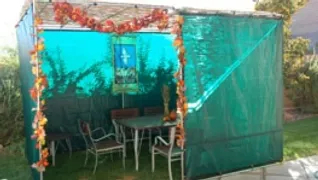
We are currently in the middle of the Jewish festival of Succot. At this time we are commanded to dwell in temporary roofless tents called a Succah in memory of how the ancient Israelites lived after being rescued by the Eternal One from slavery in Egypt and also a celebration of the harvest according to the Israeli agricultural calendar. You can see a picture of a Succah in the header image. The meaning of the word ‘dwell’ can vary according to climate, in come countries that are warm people sleep and eat in the Succah. In more inclement places such as Britain the word ‘dwell’ only means eat one meal or snack a day in the Succah however there are some hardy or mad souls such as me who try to get at least one night in our own Succah provided that it is dry as a Succah is not supposed to have a waterproof roof.
Because a Succah is a temporary and flimsy structure that will not withstand storms, tempests or bandits, in the modern world Succot has become a time when many Jews turn their thoughts to the homeless and use the festival as an opportunity to give to charities that help the homeless. Many of the Jewish festivals are an opportunity to think outside of our day to day lives and to think of the problems of the wider world. At Passover many of us think about those who are still enslaved either actual chattel slavery or those who are enslaved by drugs, ideology or women who have the misfortune to live in societies, such as Afghanistan, that enslave women. Shavuot, when the Law was given by the Eternal One, is an opportunity to think of those who have no legal redress for their complaints or who live in and with chaos and where there is no law but the whims of despots and where oppression reigns supreme.
Yesterday I went to synagogue for a Succot service where I carried out the commandment to eat and drink underneath the porous roof of a Succah with fellow Jews. The Rabbi made a very powerful speech about the meanings of Succot and asked us all one by one what makes a place ‘home’ to us. When it came to me I said ‘my desk’ as that’s where I write but I suppressed what I really wanted to say on the grounds that there were many children there and what I really wanted to say was extremely political, would have needed more explanation than time allowed and because of the presence of children was not appropriate for the occasion.
What I wanted to say is that home should be a place where a person is free from oppression. It should be a place where the State does not intervene without a good and solid reason to do so. The problem is that in Britain today our homes are not safe places from state oppression.
Whilst saying ‘my desk’ I was really thinking about something the political commentator Peter North said recently in a piece on why he supports the activist Danny Tommo. He wrote of the dangers that those who stick their heads above the parapet face in Britain today. Home for those who dissent is no longer a safe place in nations where the government is oppressive.
Mr North wrote in his piece of his arrest last year for posting a meme that took sharp and accurate aim at Hamas and those who support Hamas in Britain.
Mr North said:
As such, living the life of a professional agitator changes things. Life doesn’t go back to normal. Again, this is something I feel on my own shoulders, albeit to a much lesser extent. I sail pretty close to the wind with my tweets, because certain things need to be said, and as a consequence I’m never truly relaxed at home. I fully expect that one evening I’ll get another knock on the door, which fills me with anger and dread, because I don’t know how I will respond next time. I have lost all trust in the police.
I agree with Mr North on this. He doesn’t feel safe in his home any longer and neither do I as I also have suffered the oppressive uniformed boot of the state kicking my door in over something I’ve said that is political.
Home is only truly ‘home’ when it is a safe place. It is only when a person feels safe from crime and from the oppression of the state that a person’s home can be considered as a safe place. Too many people in Britain today have had that peace of home shattered by the State’s uniformed thugs not because they’ve committed anything that any reasonable person would class as a crime, but because they’ve strayed from the Government’s preferred narratives. Freedom from unjustified oppression is a right Britons no longer have and it will take an enormous fight to get that right back.
So, if you are Jewish, when you carry out the commandment to dwell in the Succah, as well as thinking of those without homes and the Biblical reasons behind the festival, think also of those like Mr North whose home is no longer a place of safety and has been made that way by the British state.
Links
All about Succot
https://www.chabad.org/library/article_cdo/aid/4784/jewish/What-Is-Sukkot.htm
Peter North’s piece from which the above quote was taken
https://www.northernvariant.co.uk/p/why-im-backing-danny-tommo
Peter North on his arrest for an anti-Hamas meme
https://www.northernvariant.co.uk/p/jailed-for-a-meme
My own arrest as a ‘meme criminal’ from October 2019
https://www.fahrenheit211.net/2019/10/26/im-back-and-have-i-got-a-tale-to-tell/




Be the first to comment on "Succot. What’s most important in your home? What makes home ‘home’ for you?"