Many regular readers might have noticed that I’ve been on the missing list for a week or so. Don’t worry, I haven’t passed on or been ill or been arrested (again) by London’s Metropolitan Shariah Police, I have instead been on a much longed for trip to Israel.
My wife, myself and our son were in Israel primarily to visit the Kotel (Western Wall) in Jerusalem, the holiest site in Judaism, to say thank you to the Eternal One for the miracle of the child that we prayed for when we visited there on our honeymoon fourteen years ago. However we also wanted to experience the city of Tel Aviv again as we loved it there when we stayed there before.
We would have liked to have seen much more of Israel than we did but UK Foreign Office (FCDO) and travel insurance restrictions meant that we could not visit the North of Israel or many parts of the South of the country. Because of the FCDO and insurance restrictions we could also not visit areas like Hebron nor explore the Judea and Samaria areas of the country. These restrictions also precluded doing something that I would have loved to have done which is going camping on the Golan Heights.
I’ve thought long and hard about how I will put this article together but I’ve decided to put into rough sections and see how it goes.
Israel the country and getting there.
The journey to our UK airport was badly afflicted by weather difficulties. It was a cold and wet and miserable 200 mile plus drive to the airport. We had to leave earlier than usual to cover this sort of distance as we were leaving the car in long stay parking near the airport and as we were travelling with the El Al airline we had to check in an hour earlier than would be usual and get through El Al’s admirably thorough security procedures. As as aside, if you are travelling to Israel then you should, if its affordable, choose to fly on El Al as it is probably the safest and most secure airline to make this journey to Israel on. We could have chosen a cheaper route to Israel but that would have meant long stopovers in Schipol, Amsterdam and Larnaca in Cyprus and that’s not what we thought would be practical whilst accompanied by a lively and curious nine year old.
For the first part of our holiday we were staying in a quite run down part of Tel Aviv called HaTikvah which means ‘the hope’. When I first arrived there I was quite worried as it looked like the sort of place where someone would stab you to death without even thinking about it. However that was only my own paranoia from having lived in London where comparable areas are not the sort of places where you would want to hang around on the street for too long. The area was perfectly safe and the Israelis who I met there, who appeared to be mostly of Sephardi (Spain and Portugal origin Jews) or Mizrachi (Jews whose roots are in the various parts of the Islamic world) origin and were absolutely lovely. In fact during my entire time in Israel I felt safer than I’d been for a long time and certainly a lot safer than I would have felt in London. I’m still gobsmacked that there I was in a country that is involved in a war of survival but I didn’t fear being attacked on the street by wrong’uns or being arrested for voicing opinions. One Israeli that I spoke to was astonished to find out that the UK has arrested more people in one year for speech related ‘crimes’ than the Putin regime has in Moscow. As far as I can make out Israelis have far more rights to freedom of speech than we do in the UK although I would imagine that the Israeli legal system would crack down on stuff that is reasonable to crack down on, such as genuine and credible incitement to violence.
One thing I noticed about Israel and being a Briton coming from the United Kingdom is that things worked. The trains and buses for example worked and were remarkably clean and well maintained when compared to the UK. All the public transport from the shared taxis and buses through to intercity trains are fully air conditioned. I mentally questioned the need for this level of air conditioning but having experienced the Israeli climate I now no longer do. In transport and in homes and offices air conditioning is as indispensable for Israelis as central heating or a wood or coal fire is for Britons.
As for road transport there were vehicles such as three wheeler delivery trucks (pictured below) that are almost unknown in the UK. The private road car fleet in Israel looks to be mostly of Japanese or Korean origin although I did see quite a few Renaults along with the occasion German branded vehicle about. British car makes were noticeable by their absence. In contrast to the UK I saw very few cars that had a British manufacturing heritage and very few Fords. For example I saw only one Land Rover Defender 110 and one Range Rover while we were there.
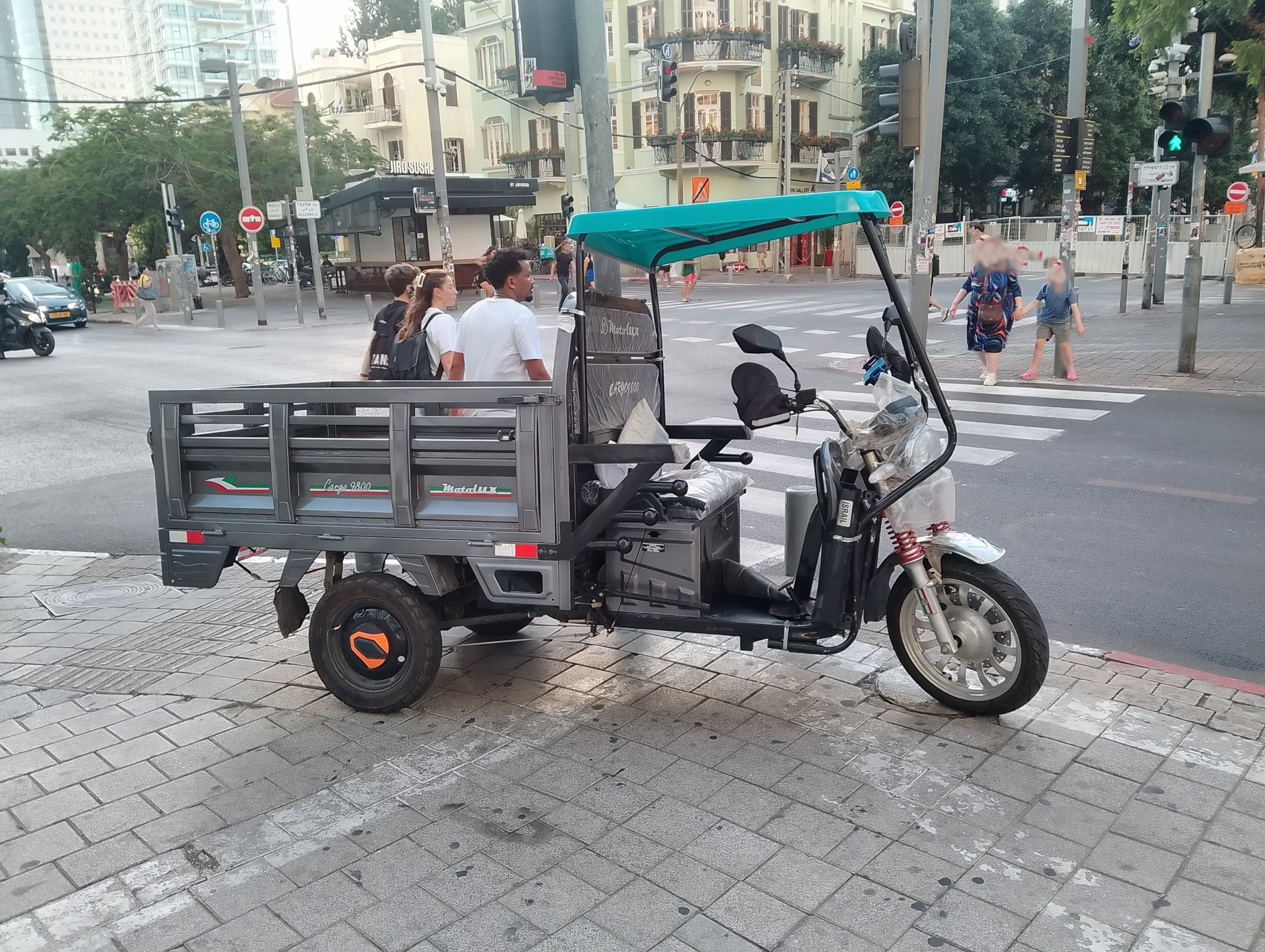
I really want one of these!
The Israelis and one noteworthy aspect of Israeli culture
The Israelis are an astoundingly friendly people. We were truly made welcome by all and they even tolerated our very bad ‘prayer book’ Hebrew which was unsuited for advanced conversational use. I was worried that I could have accidentally remade in real life Monty Python’s ‘Hungarian Phrase Book Sketch’ and say, in Hebrew ‘My hovercraft is full of eels’ (הרחפת שלי מלאה בצלופחים ) but thankfully that didn’t happen. If you can make yourself understood then you will find that the Israelis are very welcoming. They are also very pleased to have visitors especially at times like these when the Israelis are suffering greatly from the effects of the current war that is taking place both in the South and North of Israel.
Whilst it’s not a good idea to make generalisations, there’s one thing that struck me as an ex Londoner and that is the Israelis that I encountered were remarkably honest. When you visit a foreign country, especially if you are going to be in a major and dense urban conurbation, you can expect to be ripped off at some point, it’s just the way of the world and happens numerous times to visitors to London. It’s something that you just have to factor in when going overseas. However in Israel despite going into a variety of shops, cafes and restaurants etc, I only got ripped off once and that was only for four Israeli Shekels, which is about one pound sterling. But I didn’t begrudge a waitress not returning my change as I know how bad many Israelis are having it at the moment what with both the ongoing war of survival and economic woes. I treated that four Shekels as tzedakah, or an obligatory charitable donation. I think or rather I know as I’ve seen and heard of it happening, that I would have been ripped off more thoroughly had I been a visitor to London, that is if I were not shot, stabbed or bludgeoned to death by a Londoner first.
That’s another thing. I didn’t once not in Tel Aviv, after I’d sussed out the place, nor Jerusalem get the impression that my safety was at risk. We wandered around the back streets of Tel Aviv both at night and in daylight for about seven or 8 hours and never felt at all like we were about to be mugged or randomly attacked, not even by drunks let alone the sorts of violent criminal low life that have turned many areas of London into no go areas at night. There are police discreetly everywhere and in a far more reassuring number than you would find in a major British city. Also the Israelis seem to look after each other a lot more than many Britons would do. I don’t know whether this is because of a mostly shared religious and cultural mindset that Israelis have or because they all or rather most have had to serve in the military and have learned the value of greater societal bonds whilst in uniform. But what I do know is that it works.
I noticed that Israel appears to be a very high trust society. Whilst it does, as does any country, have its wrong’uns and criminals the general feel I got from what I saw was that the state trusted the citizen and the citizens trust one another. In a way it was what I imagine the early 1950’s in Britain must have looked and felt like. I wasn’t born then but I’ve read enough about that era and talked to those who have lived in early 50’s Britain to get that impression. The elderly and vulnerable along with children and their parents move freely without fear in Tel Aviv. They didn’t give the impression to me that they feared crime the way that Britons do in big cities. I wonder if these people had some sort of confidence that their society works and that their neighbours or even strangers would look out for them when they are out and about?
Another nice personal thing for me about Israel, and maybe Israelis might not realise it, is that in Israel I didn’t need to look over my shoulder when saying a food blessing. I could say the blessing for the fruit of the tree in a park or the blessing for diverse foods over a beer and nobody gave a toss. In Britain and in my local pub I’m the weird Jewish geezer who says thank you to his God for beer, but in Israel saying a Shehakol blessing over a beer is normal. I also, unlike when we visit parts of East London, don’t have to remind our son that he should be careful to ensure that nobody hears him say the blessing for a biscuit or a cola because there are ‘hostile people who don’t like Jews much’ in the area. Israel is a place where Judaism of various sorts is socially normal in a way that it is not in many other countries in the world. It’s the place where a Jewish policeman can arrest a Jewish burglar and the fact that they are both Jewish is unremarkable.
On the subject of social trust one big thing that I noticed was how public and exposed much of Israel’s critical infrastructure is. Urban electricity supplies are on high poles but each dwelling’s main gas and water pipes are exposed at street level with many having easy access valves on public view. This would never be considered in the UK. Here nobody in their right mind would consider having their main gas and water valves exposed to the potential touch of all and any passing scrotes on a pillar next to their front gate.
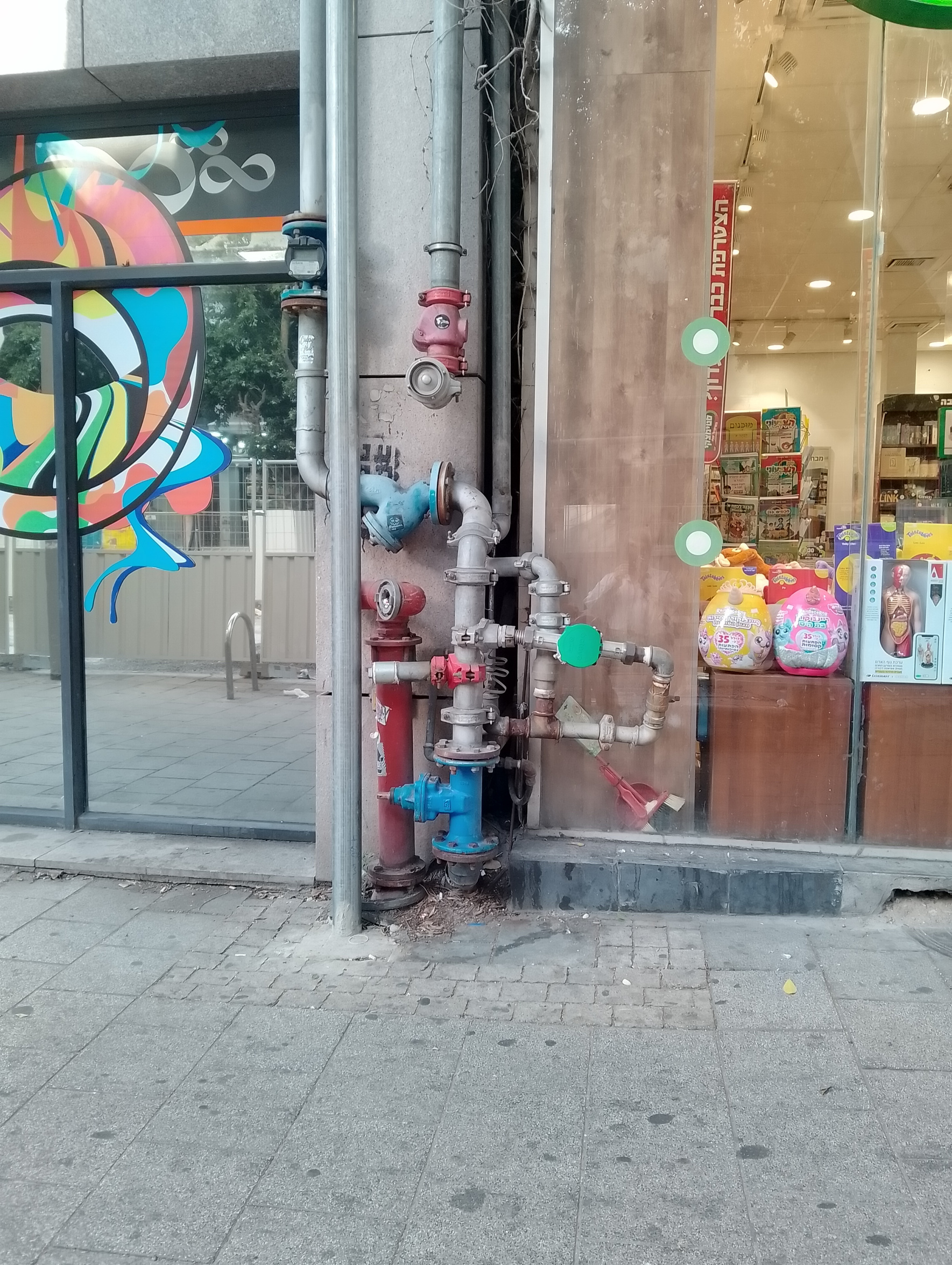
You’d never see open infrastructure like this in the United Kingdom.
If there is one thing that I noticed and was entranced by, it was to see and experience just how child friendly Israel really is. It’s a particularly noteworthy aspect of Israeli culture and one I liked a lot.
Everywhere you go there are incredibly high quality and well maintained children’s playgrounds. They are everywhere and no more than a quarter mile apart at most. Some of these playgrounds are run by the Tel Aviv local authority and some are the result of private donations. Many of these playgrounds also have attached outside gyms so that adults can exercise whilst watching their children play.
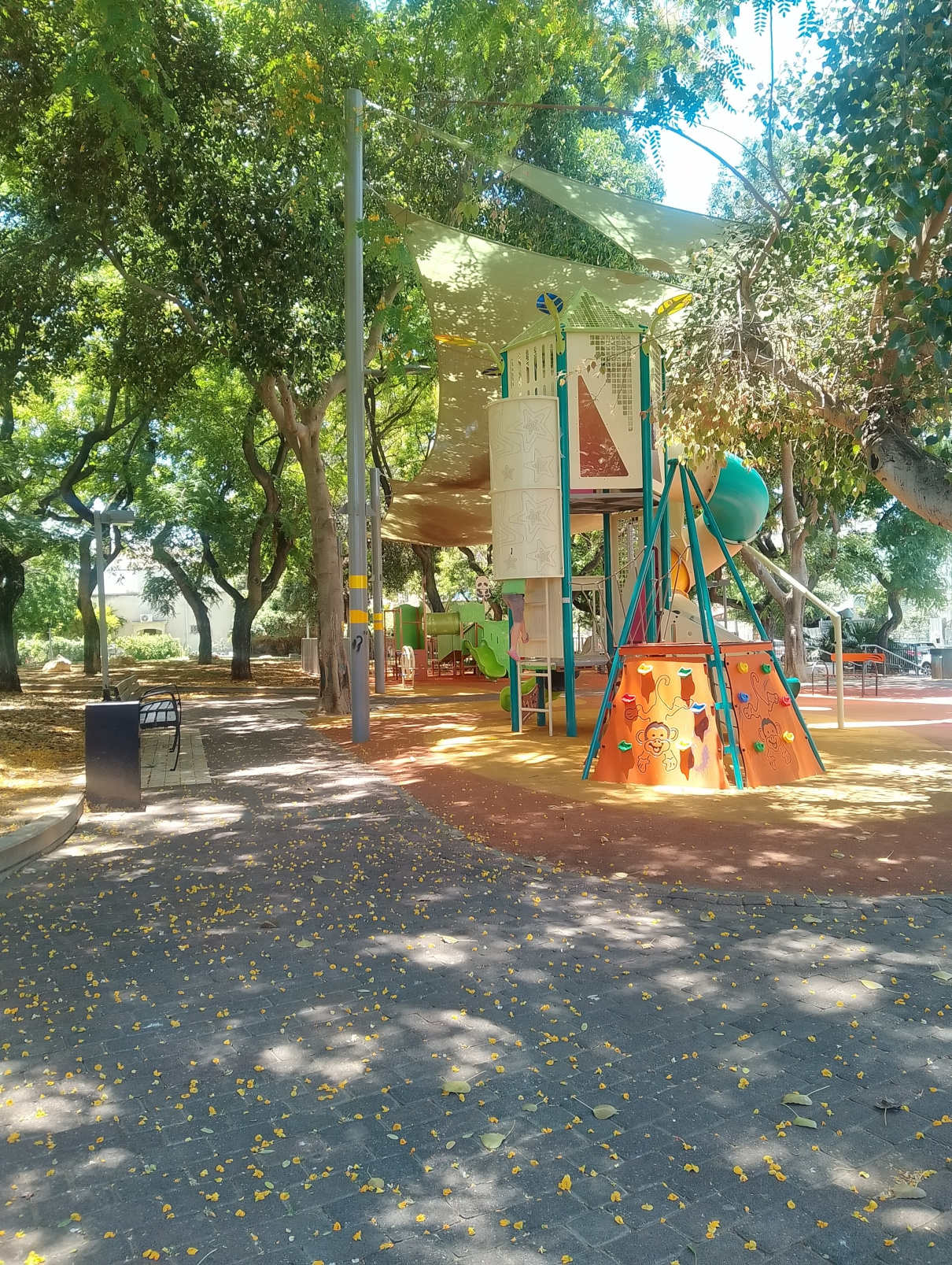
One of Tel Aviv’s extremely high quality playgrounds.
The cafes and shops that we went in were nearly all perfectly accepting of children and tolerated our son even when he was tired and crotchety. People seem perfectly happy taking their kids out into the city streets and having their children socialise with other children whilst the adults do the same.
Israeli parents seem to give their children much more of a free rein in parks and playgrounds than I’ve observed or experienced in the UK. OK I admit that I keep my child on a tighter leash than some parents but that’s because he does have a tendency to run off and explore when it’s inappropriate to do so. However it was not unusual to see the parent of a four year old be 30 to 40 yards away from their child and it not be a worry or a concern for them. It’s another aspect of what I see as Israel’s high trust social culture that parents can know that other parents will look out for other people’s children as well as their own.
There was one incident that illustrated this very different aspect of Israeli society when compared to that of the UK. My child was playing in one of the larger playgrounds in a very big and complex park. I was closely supervising him to make sure he wasn’t doing stupid stuff like blocking the slide when out of the bottom of the slide popped what looked like a three or four year old girl crying her little eyes out. Now as a Briton I know to never approach someone else’s child or interfere in the way others parent their children but like any decent human being I kept an eye on the child and looked around for her parents as I thought she might be injured. I expected to see, as I would in the UK, a highly agitated mummy or daddy rushing into the playground at the first sound of crying but this wasn’t the case, the parents were quite a way away and in a group. I might have been very British in how I approached this situation but the local Israeli parents were much more proactive, they came up and spoke to the child and asked me ‘is she yours?’ and when I said that I was not, this mother picked up this child spoke to her and managed to identify the parents. A brief shouted conversation between this woman and the child’s mother reassured the stranger who put the child down. From what I could gather this child wasn’t hurt just was having a massive whinge about something or other. But this is the main difference between Israel and the UK. A random saw a child that she thought was in distress, chatted to the child, cuddled the child and made contact with the child’s parents. I don’t think that this scenario would play out the same way in the United Kingdom, I don’t think that other parents would involve themselves so much with the situation or attempt to comfort the child even if they did try to identify the child’s parents.
It was such an amazing experience for our son and the quality of the playgrounds and other facilities was so exemplary that for a lot of the time on holiday he kept announcing ‘I want to be an Israeli’. Even though Israel must have been a massive culture shock for him having gone from being the only Jew in the village school to being surrounded by Jewish children of all races and of different Jewish religious paths, some more observant and some more secular, he loved the place. I think that even he must have noticed the difference in societal attitudes towards children in Israel when compared to the UK. There is the sort of freedom for children in Israel to grow and learn and explore that I don’t think has been seen in Britain for decades.
Before I end his section that is loosely about culture I just want to say a word about the Israeli Arabs that I encountered. I must say that I felt no animosity emanating from any of the Israeli Arabs that I encountered, whether they were secular or obviously religious. I felt that I didn’t have to fear hatred coming from Muslims who had thrown in their lot with Israel and stayed after 1948. I didn’t see them as a threat or as potential extremists or behave around them with a lot of wariness as I now have to when I travel to Islam-heavy areas of East London, they were just normal, equal and loyal Israelis but ones wearing a Hijab or other Islamic dress rather than a Jewish Kippah or Tzitzit. There is no ‘apartheid’ in Israel, everyone is equal under the law.
Jerusalem.
For logistics reasons we could not explore as much of Jerusalem as we might have liked to do. But we managed to do that which we felt we were obligated to do, which is to take ourselves and our son, the miracle baby that we prayed for at the Kotel nearly a decade and a half ago, and thank the Eternal One for his existence. It was awesome and an absolute privilege to be able to stand at the Kotel, the fabled Western Wall, the holiest site in Judaism with my son and say thank you. I never thought that the Eternal One would do the miracle of Abraham and Sarah twice but the Eternal One obviously can and did. I must admit that I burst into tears of joy at the Kotel so happy that I was there and for the reasons that I was there.
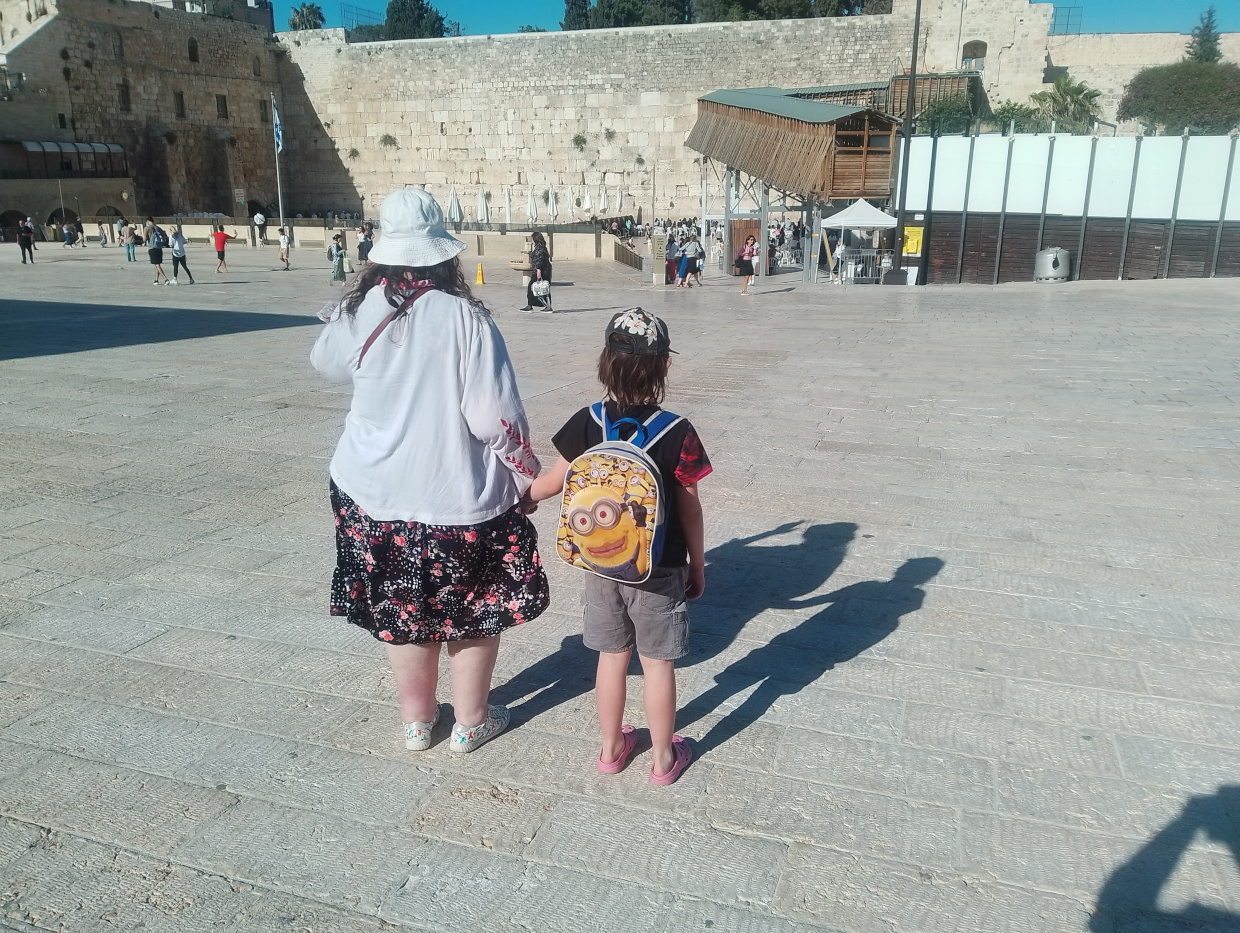
My wife and son at the Kotel.
We had an interesting journey to the Kotel. There’s a circular number one bus that leaves from a stop almost outside of the main railway station that goes quite close to the Kotel but we missed our stop and ended up back at the station again. Therefore we grabbed something to eat near the station and got back on the No. 1 bus, after working out where we had to get off to get to the Kotel.
There’s nothing like the Kotel. The feel of the place. The realisation that here is the heart of Judaism and a place that has been its heart for thousands of years and where only recently have Jews been in full liberty and have full freedom to pray.
When we got to the Kotel plaza, as the Western Wall itself is sex segregated, my wife took our son (who is not yet of Bar-mitzvah age) into the ladies section of the Kotel where she gave prayers of thanks and praise. When they returned from their prayers, I took our son into the men’s section and made my own prayers of thanks. We had hoped to get to an area of the wall to the South of the Kotel which is used as a site for egalitarian prayers, but we didn’t make it due to time constraints.
What we did experience just off the Kotel plaza however was a really good potted audio-visual history presentation of the Kotel and why the Wall, being the last remaining part of the ancient Jerusalem Jewish Temple, is of such significance. The presentation called ‘Gateway to Heaven’ didn’t tell me much that I didn’t know about history but our son found it fascinating, especially when the presentation mentioned his favourite Jewish festival which is Succos. Children are sometimes not that good in understanding or contextualising very long timescales and it amazed him that thousands of years ago there were still Jews building succahs or roofless booths and living in them for a week in the autumn whilst celebrating harvest time. Our boy loves Succos, as he enjoys the sleeping in the garden thing along with celebrating and being thankful for fruit and veg and shelter.
Israeli food
What else can I say but this: Israeli food is brilliant. It’s worth going to Israel for the grub alone. I must admit that as a former lover of the Doner Kebab I was going hell for leather with the Schwarma which is the closest approximation to a Doner but a thousand times better. Didn’t see any lamb schwarma in abundance like you would see lamb meat in a British Doner shop but plenty of beef and chicken versions.
The quality of the Schwarma I had was absolutely fabulous and I ate a lot of it because of the novelty of being able to only have to walk a few hundred yards to get a Kosher kebab instead of having to make a 300 mile round trip for the same, as I would have to do in the UK.
I was able to fulfil my promise to our son that I would take him to a Kosher McDonalds and I was again astonished by the quality. It was proper decent meat in the burgers and the vegan cheese that has to be used in cheeseburgers in Israel because of the Kosher laws was of a high quality that I have never come across in the UK. Normally I avoid vegan cheese in the UK because it often has had the same mouth feel and possibly taste as a rubber steering bush from a car, but the vegan cheese in Israel is some of the best faux cheese I’ve ever encountered.
Whilst wandering around Tel Aviv we decided that we would have one posh meal in a nice restaurant that welcomed children. We found a place near the Allenby underground station that utterly astounded me with the quality of the food. We paid about £30 per head for our meals which is a lot more than we might pay in the UK for an off the cuff family lunch but what we got for it was astonishingly good. It’s rare for me to be so impressed with what is served up to me to be raving about how good the dish is while I’m eating it but I did. I had something that I’d never thought of having which was an aubergine stuffed with beef mousaka served with rice and white beans. It was brilliant and such a large portion of food.
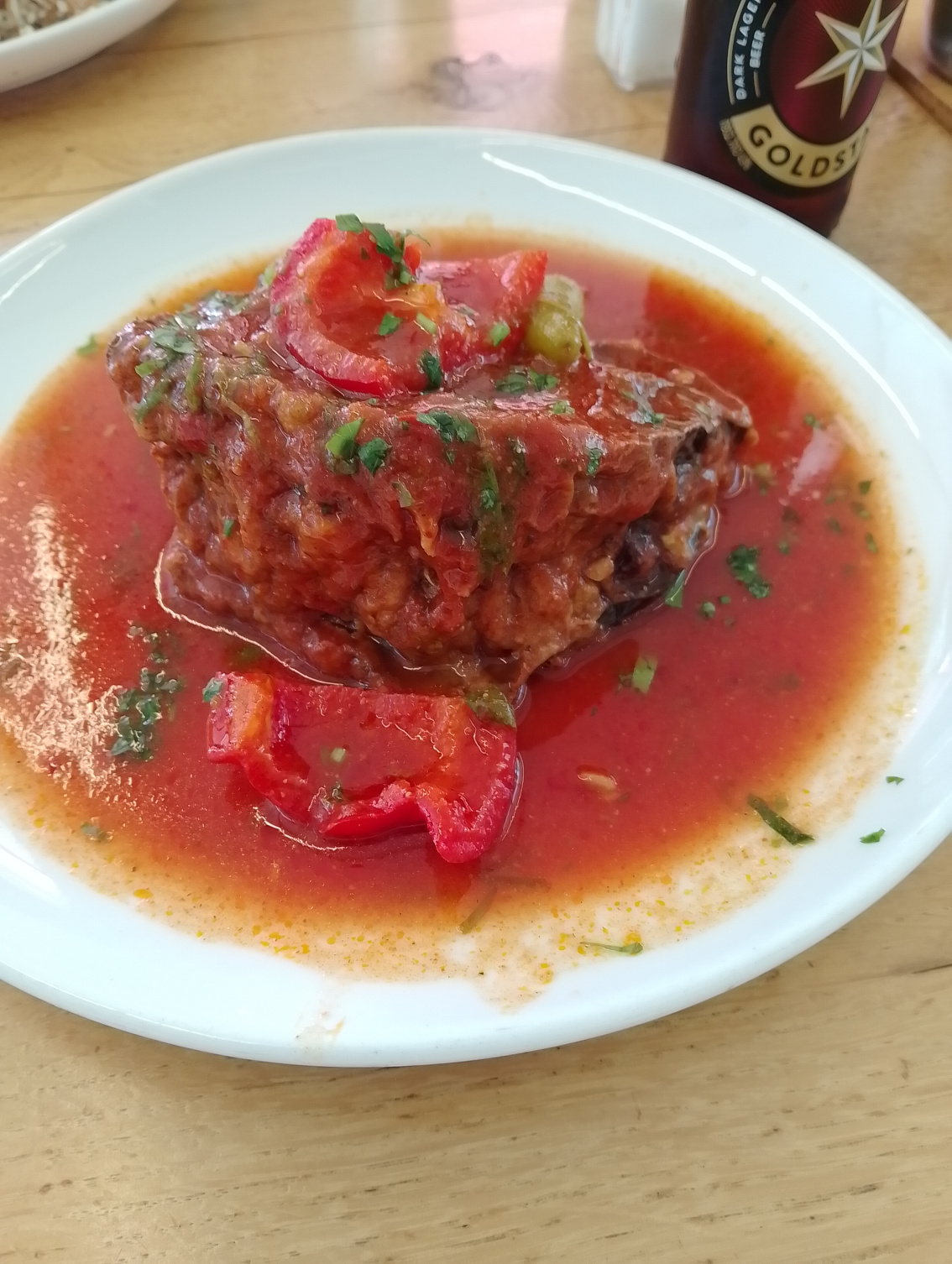
Mmm! Lovely properly prepared aubergine stuffed with beef.
My son decided that he would have a meatball with rice and he was served up a meatball which was massive and at least the size of or even a bit bigger than a cricket ball, and he liked it. My wife had a chicken and rice based dish with cranberries and carrots that she liked as well, served with a tomato and onion salad. Our son liked the salad too, even the onion which he doesn’t like in the UK.
Because Israel is the homeland of Jews whose families and ancestors have been scattered across the world since the time of the Roman Empire the Tel Aviv food scene is highly cosmopolitan and subject to a multitude of different influences. Yes, you can get stereotypical Ashkenazi Jewish food but most of the food is from every place in the world where there ever have been Jews, all mixed in with a Mediterranean / Middle East set of ingredients in things like salads.
Because we were revelling in the novelty of being able to get kosher meat dishes anywhere, we did eat a lot more meat in Israel than we would do in the UK. This is due to the cost and the hundreds of miles of travelling that we have to do to in order to get Kosher meat which means that we only eat meat once a week or once a fortnight on average and live as vegetarians the majority of the time.
If you like to eat then Tel Aviv’s your place. It’s not all kosher though and there are places that cater for non-Jews where stuff that non-Jews eat is available. I even saw a ‘Kingdom of Pork’ store in. Tel Aviv whilst traversing the city on a bus.
The only thing that made me sad about Israeli food was that I could not bring back any of the lovely white cheese that you can get in Israeli supermarkets, because UK DEFRA restrictions do not let you bring in dairy products from Israel and a number of other countries.
Hostage Square and an encounter with the Israeli police
No visit to Tel Aviv would be properly complete without paying respects to those Israelis and others who were carried off into brutal captivity by the Islamic terror group Hamas on the 7th October 2023. This memorial and remembrance point in the Dizengoff area of the city has a whole load of tributes to those whom Hamas has captured. This is a ground up memorial and not one created by the state but a memorial put together by the people for the people.
I defy anyone decent and reasonable to look at the collection of photographs and teddy bears and notes written by those who have had relatives and friends captured by Hamas and not be profoundly moved. The memorial is a heartbreaking sight and serves to remind those who pass by it not just of the tragedy of those who are missing and may well be presumed dead, but also of the bestial nature of Hamas and other similar Islamic terror groups.
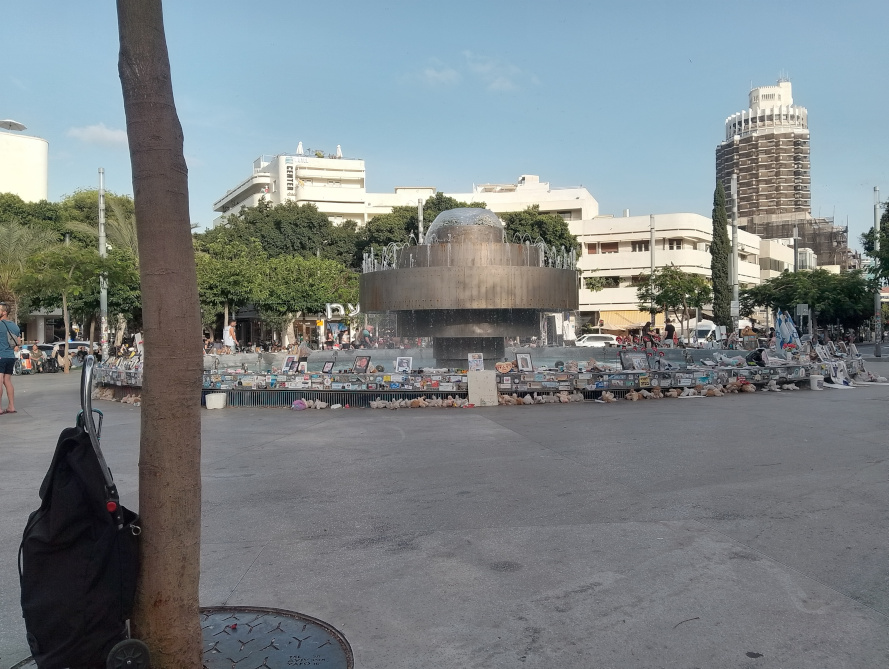
This is an image of Hostage Square in Tel Aviv. Take note of the wheeled bag on the left of the image as it will become very relevant later.
We should never make the mistake in thinking that what Hamas have done they will do only to Jews or Israelis and that this sort of violence and horror is in a far away country of which many Britons know little. This is because it’s clear from the record of decades of Islamic terrorism that what Hamas did in Southern Israel on 7/10, similar Islamic terror groups would do in New York, or London or Harrogate or Berlin or Bradford or Paris or anywhere else that Islamic terrorists and extremists have been mistakenly tolerated by the left/liberal elites of Western societies and nations.
The Hostage Square memorial was also the site of my one encounter with Israeli police. In the picture above you may well notice a black wheeled bag on the left of the picture. Someone turned up and left it, in order presumably to go and get a closer look at the memorial. However the person who left it didn’t come back swiftly, in fact five and more minutes went by and nobody came back to collect the bag.
Being brought up in London at the height of the Irish Republican Army’s terror campaign on the British mainland I have had drummed into me the danger that can be posed by unattended bags or cases (I was also very close to Hyde Park whilst working in a photographic lab when an IRA bomb went off there in 1982). I started to get a bit worried about this bag and went off to find the two police officers who I had seen earlier on walking across Hostage Square. I couldn’t find them so I went to an Israeli soldier who was sitting in a deckchair and appeared to be guarding the square and tried to make it understood that I was concerned about this unattended bag. I ran up to him shouting the Hebrew word for police but forgot the Hebrew words for unattended bag and ‘get the police now’. He clearly didn’t understand me and continued to sit in his deckchair. I don’t blame him for doing so as if I was in his position and I’d been approached by a crazy Englishman shouting the Hebrew word for police and wildly gesticulating towards something on the other side of the square then I’d probably think I was dealing with some sort of nutter as well.
After not getting much joy with the Israeli soldier I went into a little shop near the square and said in English ‘I need police now, unattended bag, danger.’ I was overheard by a woman who could speak both English and Hebrew. She spoke to me and then telephoned the police who put me onto an English speaking police controller who took down the details of my report and information about who I was. This bag had by now been unattended for at least ten minutes or so. When I was assured the police were on their way I went to depart to go back to the square but before I left the woman shook my hands and said ‘thank you for doing this for Israel’. I was surprised how pleased this lady was that I had made the effort as a visitor to report this rogue bag. It’s something any reasonable person would do.
I got back to the square just as two police officers and the bag’s original owner arrived. The police checked the bag and its owner. The bag and its owner turned out to be completely innocent and the bag’s owner had obviously never spent any time in any place that, like London for example, had been afflicted by terrorism and where it’s considered as correct to worry about an unattended bag. I apologised to the police officer for the panic over what was an innocent bag and instead of admonishing me as I might have expected or being overly and overtly cool, which is how British police might have acted, one of the police officers shook my hand and said I’d done the right thing. I could have done what others had done and ignored the bag but I could not have lived with myself if this bag had not been innocent and had instead been an IED.
Conclusion
I departed Israel with a profound sense of respect for the Israelis and how they’ve built a functioning high trust society and made what is a desert nation bloom. I have for years respected the people of Israel and admired their military and technical prowess, but this trip made this respect even deeper.
There is much that the Israelis have done and built that I’d love to see copied by countries like the UK. Their education system has turned out millions of people who respect learning and their national service system has helped to bring people of diverse backgrounds and races together.
It’s obvious the average Israeli loves their nation and that is evidenced by the many Israeli flags that ordinary people fly from their balconies, their cars and from their own flagpoles. I was struck by the different attitudes to the national flag between Israel and the UK, as in Israel people are proud to fly their national flag whereas in the UK we’ve got a situation where people fear flying our own flag for fear of causing offence to those who hate Britain or running foul of the bureaucrats who see nothing to be proud of in the British nation or Britain’s national story. I’d like to see far more Britons getting their Union Flags out and flying them and defying those who believe that doing this is something shameful.
So, would I move to Israel? Well the answer to that question at present is no and it’s not because of either the security situation or the fact that our son would have to serve in the Israeli military. One reason for this point of view is I don’t believe that the United Kingdom is finished as some think it is. A better Britain is possible. Also I can’t get out of my head a recruiting poster that went up in heavily Jewish areas of East London at the time of the First World War which read: ‘England has been all that it could be for the Jews and now it is time for the Jews to be all that they can be for England’. I must at least for now stay in the UK and fight the political fight alongside others of similar views in order to help put right the errors that have been made in the UK by successive governments, including those governments that contained politicians that I once supported. There may come a time when I HAVE to move to Israel for security and safety reasons, but not yet. I’m not sure that I could cope with either the high cost of living there or living in an urban environment again and I’m worried that my skills are not those that Israel has a use for. Another factor is the lack of non-Orthodox synagogues in Israel. There is only one such synagogue in Tel Aviv and that bothers me as I am used to being able to go to a different shul if I disagree with either the Rabbi, the service format or, as happened in one case in the UK, the synagogue management goes mad and decides to do something stupid such as try to hammer the square peg of Marxism into the round hole marked ‘Torah’. I like to have a choice of synagogues, both ones I want to attend and those which I wouldn’t be seen dead in.
What I found in Israel was the complete polar opposite situation to what media organisations like the BBC tell us it is. I found a confident, pluralistic, equitable and welcoming society and I have left Israel knowing more about it and with a considerable more respect for Israelis and the society and nation that they have built.
If you haven’t been to Israel, whether you are Jewish or not, then go and visit. See for yourself what Israel is like and cease to listen to those who have very dark motivations to hate on Israel and Israelis. I’m definitely going to go back for another visit if I can, but next time in Jerusalem and elsewhere in Israel, I will hopefully have better and more appropriate Hebrew language skills.
Am Israel Chai (The people Israel, live).




Glad you enjoyed your trip to Israel with your family.A very interesting report on your time there.🙂
It was great and I’m glad you like the report.