
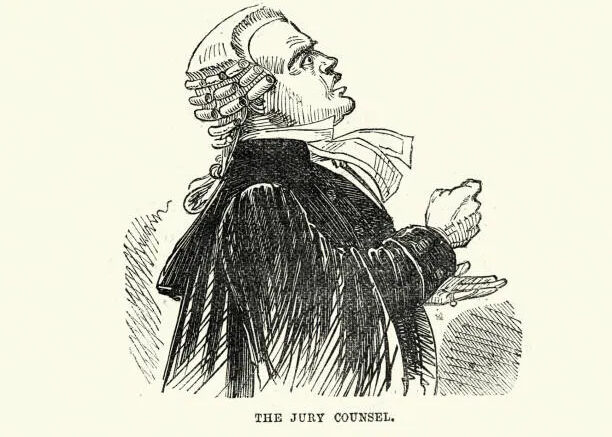
The recent story of a man who lied about his educational history when approaching a Barristers Chambers for employment but was rebutted when his lies were discovered and who then appealed and won his case reminds me of a counsel I once knew. This particular counsel really was as I recall was one of the worst legal counsel I’ve ever seen.
Many years ago when I was a court reporter there was a barrister who was genuinely incompetent. I’m not going to name him as there’s a chance he might still be alive. He was awful. He didn’t manage his case documentation properly, had poor advocacy skills and created delays and disruption to cases due to his incompetence. He would also spout irrelevant nonsense in court and I would not be at all surprised if Judges sighed when it became known that this counsel who I will call ‘Mr A’ in this piece would be appearing for the defence. He was so bad that Judges often had send the Jury out of court temporarily in order to tell Mr A to stick to relevant points or to correct Mr A on points of Law. He was the sort of counsel that I would not trust to represent me in court even for a speeding ticket case. He really was that useless.
However he was popular with some defendants even those facing major charges such as armed robbery. The reason he was popular especially with Black defendants because this barrister was Black himself. Defendants picked Mr A almost totally on the grounds of race and this often didn’t work out well for them.
This counsel was so completely useless that whenever we as court reporters found out he was appearing in one of the London Crown Courts we would rush off to the court where he was appearing at because we knew that Mr A would almost certainly say something stupid or outlandish which might turn out to be newsworthy. We understood that barrister Mr A would shout ‘racism’ about everything that happened in the court even or about how his clients had been treated by the police when such a claim was clearly unjustified and without any credible evidence. Mr A was the sort of barrister who could be guaranteed to say something irrelevant or stupid or be comically incompetent. He was great for those of us looking for a laugh but not so great for his clients.
The sad fact about Mr A is that Black defendants picked Mr A because of his race alone. They didn’t consider whether another barrister from a different ethnic group might have been more effective or might have fought their legal corner better.
There were probably Black defendants in cases where the defence was handled by Mr A who might not have been convicted if they’d had better counsel or who might have got lesser sentences but didn’t due to Mr A’s piss poor mitigation upon conviction. A more talented barrister might have been able to discern holes in the police’s evidence or throw doubt on witness statements or be more effective at cross examining the Crown’s witnesses. Someone who was a genuinely talented counsel might have represented their clients far more effectively than Mr A did.
The case of the useless barrister I’m calling Mr A is a classic case of the pitfalls that a person can fall into by picking a counsel on the grounds of racial or political affinity and not selecting counsel on the grounds of talent and record of achievement. Were there defendants who Mr A represented who were not guilty but due to Mr A’s poor representation were convicted and imprisoned? Of course there were. Were there defendants who might have got into rehabilitation instead of gaol because of Mr A’s piss poor court performances? Again I believe there were.
Those Black defendants who picked Mr A on the grounds that Mr A was Black and for no other reason shafted their own cases. People who are facing criminal charges in the Crown Courts should select their counsel on the grounds of reputation, talent and specialist knowledge. If for example you are a person from East London facing a speech crime charge in the Crown or even in the lower courts, you would not and should not choose the barrister just because they share the same background as you or because they have the same accent as you. What you need to do is select a barrister on the grounds that this person has a good reputation for fighting free speech cases.
I learned very early on in my working life that affinity hiring whether it be for racial, political or other reasons is setting the defendant up for a disadvantage. The Crown will choose the best talent to present their cases to the court so why shouldn’t you? There’s probably people out there with serious criminal records for stuff they might not have done because of the incompetence of counsel such as Mr A. Don’t be like them. Chose the best counsel you can afford irrespective of what race they are, where they came from, the counsel’s political views or whatever. There’s some brilliant legal talent out there who will do all that they can to represent you in court, choose them instead.
Link
The case of the counsel who lied on his CV





Re Mr. A: “The sad fact about Mr A is that Black defendants picked Mr A because of his race alone. They didn’t consider whether another barrister from a different ethnic group might have been more effective or might have fought their legal corner better.”
I think we might now know why black people are ‘over-represented’ in prison, it’s not “systematic racism” (it never was), but affinity hiring, perhaps?
As for Anu Mohindru: “A tribunal disbarred him for telling his 23 Essex Street interviewers a “reckless, foolish and completely unnecessary lie” about studying at Oxford, and because he
“doubled down” on his CV. On appeal at the High Court, Mr Justice Johnson overturned Mohindru’s
expulsion, stating that it “would be wrong to impose the ultimate sanction merely because dishonesty is present”.”
I found that deeply disturbing and especially the word “merely”. So being dishonest is not a bar to the bar? So much for integrity in the legal system.
Just wait until he becomes a judge.
The danger of affinity hiring is that you get a person who looks like you but might not be the best fit for your needs. Agree also that accepting dishonesty in those called to the Bar might impact on the quality of judges somewhere down the line.
I fully agree with Jon MC. The major reason for the sanction in such cases is not the nature of the lie, it is the fact that the person was dishonest.
The whole of the English legal system is based on honesty and trust – “I swear to tell the truth, the whole truth and nothing but the truth”.
Counsel are not there just to represent the defendant, they are also officers of the Court, there to help the proper procedure along, and Judges trust that they are being honest in their representations, the whole system would grind to a halt if judges had to have proof of eveything counsel say.
We are seeing the effects of the lack of trust in the USA, where some Department of Justice counsel have been so evasive or, indeed, outright dishonest so many times in cases regarded as politically important that judges are no longer trusting what they say and this is affecting the whole conduct of cases, not only those where lies have been told, but also others where the same counsel or prosecuting office are involved and the judges no longer trust the counsel.
Honesty is the most vital quality for those involved in the system. Mr. Justice Johnson is completely wrong in this case, in fact one must question his whole understanding of the fundamentals of the system of which he is such an important part .