
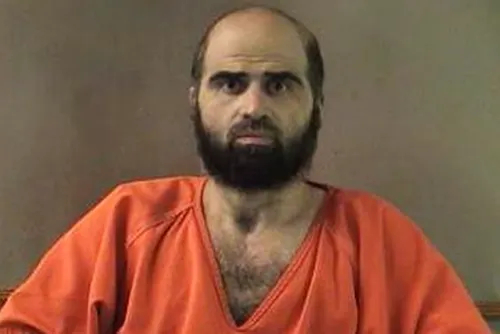
Apparently there has been a change of heart by the US government over the issue of livestreaming the execution by firing squad of former US Army Major Nidal Hasan. Hasan is due to be executed in early December 2026 under US Military Law rather than Federal or State Law where execution by firing squad is an option alongside lethal injection.
Hasan killed 13 people and injured many more in a 2009 gun attack on US Army personnel at the Fort Hood military base in Texas. There is little doubt as to Hasan’s motivation as he was heard shouting ‘Allah hu Akbar’ whilst carrying out his murderous spree,
The US Government were initially intent on having the execution of Hasan livestreamed but they’ve now backed down on this desire now. To be frank I’m not that surprised. From what I can gather from looking at US media, the public are very much in two minds whether livestreaming the demise of Hasan is a moral thing or not. Also there’s been a very long wait for Hasan’s demise at the hands of the US State because of the lengthy appeals process. All avenues of appeal for Hasan are now closed to him and he’s now got a definite date for an execution.
From what I can understand the plan to livestream the execution may run into a few problems apart from a body of the public who believe that livestreaming Hasan’s execution is barbaric. There’s the issue of who watches? I understand that both Federal and many State laws forbid the presence of under 18’s at executions, livestreaming Hasan’s execution may well fall foul of this precept. Live streaming the execution, provided that the US Govt could find a carrier willing to show it, makes it likely that some under 18’s would view this execution.
Then there is the possibility of a challenge to the live stream under the 8th Amendment to the US Constitution which forbids ‘cruel and unusual punishment’. It could be argued that livestreaming something like an execution that has since the 1930s in the USA been something relatively private might constitute ‘cruel and unusual punishment’. One possible tactic would for lawyers for Hasan or anti Death Penalty lawyers per se to claim that the added stress to the felon of knowing that their last moments would entertainment for the prurient might constitute ‘cruel and unusual punishment’. It is also possible that an 8th Amendment challenge could be on the grounds of an excessive post mortem punishment as the 18th century debates that formulated the 8th Amendment classified Gibbets, which were primarily used post-mortem in places like Britain at the time, as being ‘cruel and unusual’.
Such legal actions would inevitably delay the long awaited execution of Hasan. Whatever my personal view of the death penalty, the American people have waited a long time to see this jihadi savage despatched. If the US government had stuck to its guns and gone ahead with livestreaming then it’s likely that Hasan would breathe for a bit or maybe a lot longer.
The US Government climbing down over the issue of livestreaming Hasan’s execution was probably the most sensible decision. Going ahead with it would have opened up a whole can of worms that not only would cause a political furore but might well delay the justice that is coming for Hasan.
Link
The text of the 8th Amendment to the US Constitution.
“Excessive bail shall not be required, nor excessive fines imposed, nor cruel and unusual punishments inflicted.”
https://www.archives.gov/founding-docs/bill-of-rights-transcript
Background
The roots of the 8th Amendment in the British 1689 Bill of Rights





Be the first to comment on "An unsurprising decision."