

Christopher Talbot, a Law Student has made some very interesting factual commentary and observations on the angry public outburst over two Traveller teenagers aged 14 and 15 who were sentenced for a series of pretty brutal rapes. This piece is not to dwell on the crime itself but on the public furore about the non-custodial sentence that the teenagers got. Personally, going by the reports on the teenagers and the revelation that one was mentally backward and the other didn’t understand the concept of consent, I’d have plumped for some form of mental hospital order if gaol was off the table but then that’s just my opinion.
Most of those comments that I’ve seen are blaming the Judge in this case. Maybe the Judge was overly lenient but the Judge really didn’t have any choice but to be lenient due to the content of the legally binding Sentencing Guidelines. It’s believe it’s wrong to blame an individual Judge for following guidelines that may be heavily influenced by all manner of liberal/left legal luminaries including Sir Keir Starmer. These guidelines, which cannot be ignored by Judges, make it incredibly difficult to gaol minors for even quite serious offences.
Here’s what Mr Talbot said on X:
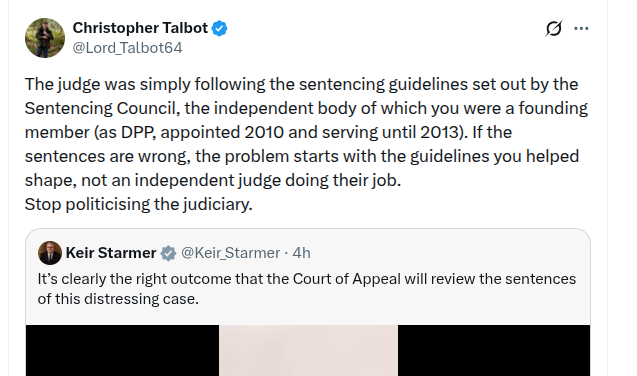
https://x.com/Lord_Talbot64/status/2059241068919410783
Sometimes there are root causes in problems in the justice system, a period or an instance when you can’t point to a change in how the legal system acts and see that is where the problem originated. A good example of this is the Bloody Code in England and Wales in the 18th and 19th centuries. The Bloody Code was a series of laws, primarily supported by the wealthy and landowners to attack ruthlessly all forms of property crime. Under the Bloody Code even minor offences of dishonesty were punishable by death and crimes such as Petty Treason which included the murder of a master by a servant or a husband by a wife emphasised the differential way the classes and the sexes were treated by the justice system of the time. We can look at the Bloody Code and see where it started see the root cause of it, wealthy Britons fearful of their own nation’s lower classes and worried about the ripple effects of the French Revolution coming to Britain. The Bloody Code was brutal but eventually juries are said to have started to refuse to convict for minor property crime that would have led to death sentence so it was a brutal but ultimately self defeating part of British judicial history.
Just as we can see a root cause for the Bloody Code in the fear of the Establishment of the ordinary working Briton so we can also see the root cause for much of the lenient sentencing that so many people are getting excited about. That root cause could well be the Sentencing Guidelines and Sir Keir Starmer KC MP.
Back when Starmer was the Director of Public Prosecutions (DPP) between 2010 and 2013 he was heavily involved in the putting together of the Sentencing Guidelines from his position as a member of the Sentencing Council. I cannot at this moment find the names of the original members of the Sentencing council but it is made up of judges, defence and prosecution counsel, victims advocacy groups, academics and others. What I am sure of is the DPP’s involvement in the sentencing council. Since it was set up in 2010 the Sentencing Council has governed what sentences which offender will get for their particular crime. It was set up in part to improve the consistency of sentencing in the criminal courts but it may have caused or facilitated other negative issues.
Whilst the Sentencing Council has most likely improved consistency of sentencing it may also be the case that it is also at least partly behind the overly liberal instructions that Judges are given on sentencing, the other is the overstretched condition of Britain’s prison estate. A Judge may feel themselves that for example a man caught with thousands of images of child sexual exploitation (CSE) deserves gaol but their hands are tied by the Sentencing Guidelines that a Judge cannot ignore, therefore a community penalty is applied and not gaol. If you want to find a root cause for sentences such as this it is the Sentencing Council and those, including Starmer, who shaped it in its early days. It does make me wonder, knowing Starmer’s preference for the legal circles of the Left, how much influence he may have had on the general direction of the Sentencing Guidelines? Did Starmer set the Sentencing Council on its current path, which appears to be a very liberal one and the organisation has drifted more liberal and less concerned with victims or punitive punishment as time has gone on? It is an interesting question to ponder is it not?
Mr Talbot added:
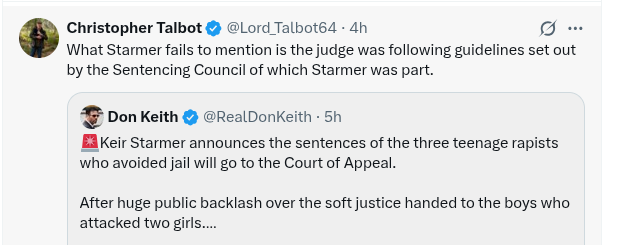
https://x.com/Lord_Talbot64/status/2059240068326289499
Starmer’s fingerprints might be all over the Sentencing Guidelines. He was DPP at the founding of the Sentencing Council and maybe Starmer should disclose whether or not he was behind the direction that the Sentencing Council and the Sentencing Guidelines went? On the other hand Starmer may say that these issues ‘never crossed his desk’.
We can point to the creation of the Sentencing Council and Guidelines as one where the criminal justice system became less retributive and more rehabilitative. Now don’t get me wrong, I’m a great believer in rehabilitation, it is possible for some people who have been criminals to turn themselves around with help, but there needs to be balance between rehabilitation of offenders, the protection of the public and ensuring the public’s confidence in the criminal justice system. The problem is at present there is no balance. Offenders needs may be being prioritised because of an overemphasis on rehabilitation, people who should be away from the public for the public’s safety are out on the streets and the direction that the Sentencing Council has taken has knocked the public’s confidence in the criminal justice system.
Maybe it’s time to return more to the situation where Judges had more freedom in their sentencing powers? Oh I know the downsides of that such as inconsistency of sentencing and the difficulties that defence counsel will face in ascertaining what sentence their client might get and how this will affect how counsel give advice to their client, but it might be better than having a Sentencing Council that seems to be tipping left and tipping too far towards rehabilitation of offenders and away from public protection.